The way people search is undergoing a quiet but profound transformation. Until recently, the typical user journey started with a search engine, followed a path of blue links, and eventually landed on a product page or brand website. But with the rise of generative AI, particularly large language models (LLMs) like ChatGPT, Google’s AI Overviews, and platforms like Perplexity, users are increasingly beginning their journeys in conversational, exploratory environments.
These tools allow users to ask broader, more nuanced questions and receive synthesized answers. The experience feels less like sifting through links and more like speaking with an informed guide. As a result, discovery is no longer limited to the SERP (search engine results page). Now, it often begins with a dialogue.
And as these platforms grow, so do the signs that the AI layer itself may evolve into a commercial environment. In recent months, ChatGPT has come under scrutiny for interface features that resembled ad-like app suggestions,prompting OpenAI to clarify they weren’t paid placements, as reported by TechTimes and TechCrunch. Meanwhile, ChatGPT could introduce paid ads or sponsored suggestions at some point in the future, even if nothing has been formally confirmed.
What this reinforces is simple: the AI-driven discovery phase is expanding, and commercial opportunities are likely to follow. The platforms shaping early-stage exploration today may very well become the paid environments of tomorrow.
In short, AI is reshaping the starting line. But one thing hasn’t changed: when it comes to purchase decisions, user behavior still pivots back to what works, and paid media retains its critical role.
LLMs are rewriting the discovery phase
The shift in search behavior isn’t only cosmetic, but structural. Large language models (LLMs) like ChatGPT, Gemini, Claude, and Perplexity AI are fundamentally changing how people explore and evaluate information online. These tools don’t just retrieve links; they curate and synthesize insights, often drawing from multiple sources to deliver an “answer” rather than a list of options.
This creates a new kind of digital gatekeeping. Instead of users scanning results and making comparisons on their own, LLMs act as intelligent intermediaries, deciding which brands, messages, or features make it into their responses. That means if your brand isn’t present, clear, or relevant in the places these models pull from, you risk being excluded from the conversation entirely.
But this doesn’t signal the death of brand interaction. Instead, it means that engagement is happening earlier and more subtly. Where traditional search behavior might lead someone to a homepage or landing page, an AI-driven query might summarise your product or service without ever sending the user to your site. That changes how visibility and influence are measured.
Adoption of generative AI for search and information discovery is accelerating across North America and Europe. In the U.S., an AP–NORC study shows that around 60% of adults now use AI tools to search for information, making it the most common AI use case. Pew Research adds that 34% of U.S. adults have used ChatGPT, with a growing share relying on it to learn, evaluate options, and explore topics in depth. Canada mirrors this upward trajectory, consistently ranking among the highest per-capita users of ChatGPT based on global traffic patterns.
Across Europe, adoption is expanding at pace. A 2025 multi-country survey from the Reuters Institute and the University of Oxford found that 61% of respondents had used a generative-AI tool, with weekly use nearly doubling year on year, while insights from Statista and IPSOS show the same pattern emerging globally: users increasingly turn to AI tools as their first stop for ideas, comparisons, and recommendations.
But discovery is only the first step. When intent deepens, people don’t just want information, they want solutions. And that’s where paid media continues to prove its value, guiding high-intent audiences from exploration to action.
But purchase intent still relies on classic search
While AI tools have changed how users explore, they haven’t replaced how users act. When real intent surfaces, like making a purchase, scheduling a service, or finding a store, people still rely on the proven structure of search engines. It’s familiar, fast, and effective.
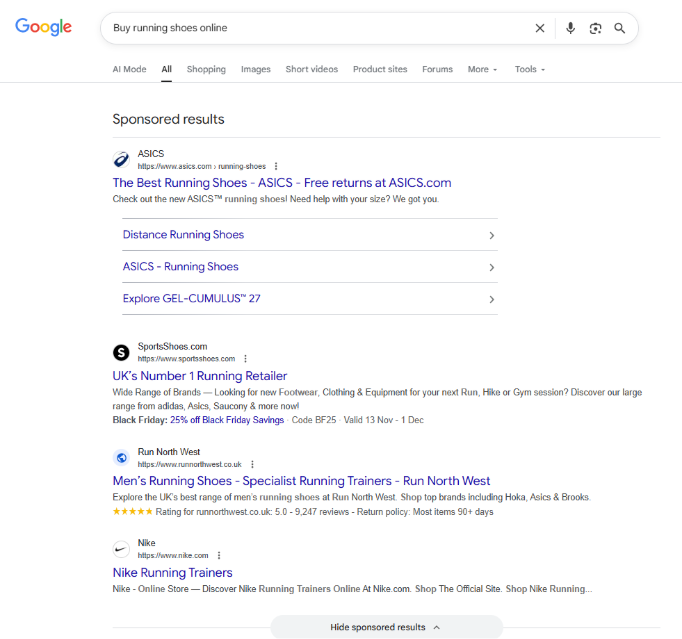
Transactional queries (“buy now,” “near me,” “book today”) are far less likely to trigger AI Overviews or conversational answers. Google itself has stated that AI Overviews typically do not appear on commercial-intent queries. Instead, those searches return classic results: organic listings, shopping ads, and paid search placements.
Search Results for High Intent Queries
As AI expands the exploration phase, the path to conversion narrows back into well-established, high-performing formats. In other words, performance media still captures the moment when intent becomes action. You can explore this dual-layered journey and how brands should respond in our latest Media Playbook.
It’s also worth noting that while AI Overviews can reduce click-through rates, that impact softens when the brand is mentioned within the overview itself. Visibility still matters, just earlier in the journey and in more dynamic formats.
The bottom line? AI might shift how users start their journey, but it doesn’t change how they end it. Paid remains decisive at the point of conversion.
The CTR shift is real, but brands can adapt
One of the clearest impacts of AI Overviews and LLM-driven search results is on click-through rates. When users get answers directly in the results page, consolidated and conversational, they’re naturally less inclined to click on individual links. That includes both organic results and paid placements.
But here’s the nuance: lower CTR doesn’t equal lost intent. The need is still present, but it’s being addressed earlier, in formats that weren’t part of the journey a year ago. According to Search Engine Land, both paid and organic results experience significant CTR drops when an AI Overview is present.
However, that effect isn’t evenly distributed. When a brand is directly mentioned within the Overview, the CTR decline is much softer. Those mentions act as early trust signals, helping brands stay in the user’s consideration set even before a click.
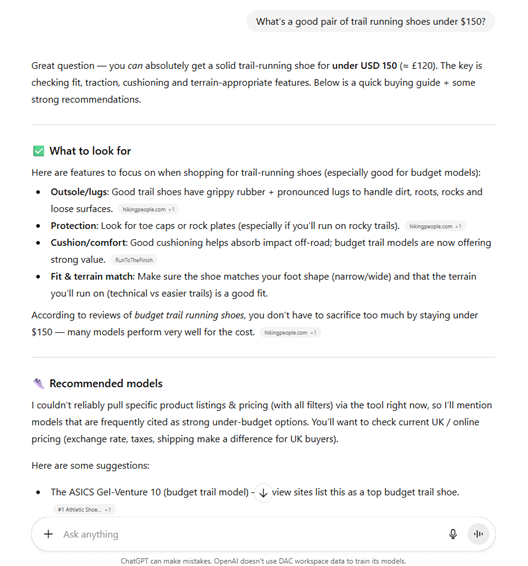
ChatGPT in the Discovery Phase
So, while visibility is shifting, it hasn’t disappeared. It’s migrating earlier in the journey, into environments that don’t always produce a direct response but still influence perception and decision-making.
This is where strategy matters. It’s not just about where you appear, but when and how. Brands now need to show up during exploration, influence in the interim, and convert when the time is right.
From channels to continuity: Rethinking strategy
The evolution of search isn’t just a technology shift, but a strategic one. As AI reshapes how users discover information, the traditional notion of “channels” becomes less relevant. What matters now is continuity: being present across the full journey, from curiosity to conversion.
Generative AI has introduced a new top layer to the funnel, one that’s more fluid, less predictable, and harder to attribute. Users aren’t just typing queries into Google anymore; they’re asking follow-up questions in ChatGPT, comparing answers in Perplexity, or passively receiving AI-generated summaries on search results pages. These environments blend content, comparison, and conversation into a single moment, often without a clear click path.
Meanwhile, the transactional stage remains more structured. Paid media still plays a crucial role in capturing demand once users are ready to act, but that doesn’t mean it should operate in isolation. It needs to be part of a connected ecosystem that spans the full journey, not as separate tactics, but as reinforcing touchpoints.
Thinking in terms of continuity helps shift the mindset from campaign-based execution to always-on visibility. Brands that embrace this layered approach can meet users where they are, however they choose to explore and guide them confidently toward conversion.
This isn’t about replacing one channel with another. It’s about building strategies that adapt to a landscape where exploration is AI-led, but decisions are still grounded in traditional behaviors.
Paid media still closes the journey and expands into AI
Despite all the noise around AI disrupting search, paid media continues to do what it does best: capture high-intent moments and drive measurable outcomes. What’s changing isn’t the value of paid, but the environments where it shows up.
Users still rely on traditional search results to make purchase decisions. When they’re ready to buy, book, or visit, they turn to structured formats where paid placements offer clarity, choice, and speed. That foundation hasn’t moved.
But what’s new, and increasingly relevant, is how paid media is beginning to extend into the AI layer itself. Platforms like Perplexity are experimenting with native ads, and OpenAI’s “Instant Checkout” shows how commercial features are now appearing directly within conversational interfaces.
These aren’t side features, but early signs of how paid media will evolve. In the near future, paid placements won’t be limited to search engines; they’ll also exist inside AI environments, influencing decisions at earlier, less structured points in the journey.
The takeaway? Paid isn’t being displaced but redistributed. It still owns the final step of the journey, but it’s also gaining a foothold in the exploration phase.
It’s not AI vs. Paid, it’s AI + Paid
AI is changing how people explore, compare, and consider. But when it comes to deciding, when the need is clear and the intent is strong, paid media still drives the outcome.
The future of search isn’t about one replacing the other. It’s about recognising that AI and paid now work in tandem. One shapes awareness and early impressions; the other delivers clarity, choice, and action. Both are essential.
This shift calls for a more connected approach that’s less about siloed channels and more about presence across the entire journey. From conversational exploration to transactional readiness, brands need to show up with relevance, consistency, and intent.
The brands that understand and embrace this duality will be the ones that not only earn visibility and attention but drive meaningful conversions.
If you want to dig deeper into how the search landscape is changing, we’ve broken it down in our latest Media Playbook. It explores how evolving platforms, user behaviors, and technologies are reshaping the entire media ecosystem and what it means for performance.