Seamless data integration
Aggregate your brand’s data, apps, and systems into a singular view to reveal new opportunities, inform business decisions, and unlock bigger outcomes faster.
Inspired decisions demand clarity
Combining insights, functions, and workflows across multiple sources often causes more confusion than clarity—confusion that makes it impossible to rely on your data. Our full-service data integration solutions connect numerous inputs from disparate sources to reveal pivotal truths that inspire decisions.
LET’S TALK DATA INTEGRATION
Streamline your operations with DAC Group’s data automation and integration services. We connect and automate data flows to ensure seamless communication between systems. Our solutions reduce manual processes, improve accuracy, and enable real-time decision-making.
With DataAnywhere, our exclusive suite of helpful APIs, we ensure smooth and secure connections that enhance user experience and operational efficiency. Our solutions are designed to simplify processes, save time, and keep your business data synchronized and accessible.
Gain deeper insights with DAC Group’s synthesized reporting services. We consolidate data from Google Analytics, Adobe, and other platforms into cohesive, easy-to-understand reports. Our approach gives you a clear view of your performance metrics across all channels, empowering you to make data-driven decisions.
We provide you with custom dashboards that offer real-time insights into your key metrics, accessible anytime, anywhere. Our dashboards are designed to be user-friendly and actionable, giving you the power to monitor and manage your digital performance around the clock.
Tailor your technology to your unique business needs with DAC Group’s custom software development services. From concept to deployment, we create bespoke software solutions that integrate seamlessly with existing systems.

Move your brand forward with our award-winning capabilities

Global Business Technology Awards
Digital Agency of the Year.

Development team
A team of more than 75 professionals dedicated to web and software development.

Proprietary platforms
Our own in-house tools to meet unique needs, including TransparenSEE and IRIS.
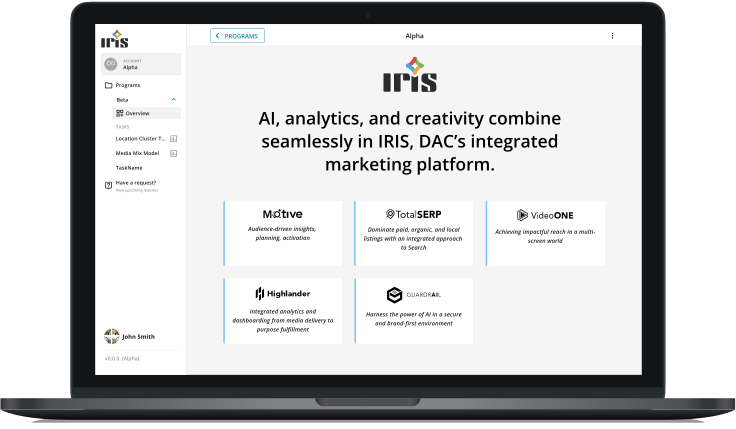
Do more with your data. Much more.
IRIS, our AI-powered integrated marketing platform, is the natural result of our leading data integration practices. This unique tool joins the dots across your marketing efforts to reveal the elusive insights you need to drive powerful business outcomes.
EXPLORE IRIS
Proprietary tech built for powerful outcomes

TotalSERP
Orchestrate cohesive search strategies to dominate across paid, organic, and local.

TransparenSEE
Effortlessly manage, monitor, and optimize local listing data across all sites.

Guardrail
Supercharge AI productivity by streamlining interactions and maximizing efficiency.

Highlander
Streamline analytics and reporting, enhancing decision-making across marketing channels.
Seamlessly integrated for impact
Data integration can be a standalone solution, but it’s also an integral part of larger media initiatives—including Enterprise-to-Local strategies. Layer in data integration to paint a richer picture of your brand’s strengths, performance, and opportunities.
Data integration in action
How to make brands safer and stronger in an AI world
Is your company embracing AI for marketing efficiency or setting up guardrails due to brand safety concerns? Stay ahead in the game and strike the right balance between AI benefits and brand safety.
DOWNLOAD THE WHITE PAPER
FAQ
A marketing data integration strategy should reduce decision fragmentation by connecting the systems that shape planning, activation, and measurement into one usable foundation. The value is not integration for its own sake; it is giving teams a cleaner path from data to action.
An AI-ready marketing data foundation requires consistent, accessible, well-governed data that connects customer, media, CRM, and outcome signals in ways models can actually use. Without that foundation, AI tends to amplify noise, gaps, and conflicting definitions instead of delivering better insight.
Every enterprise data integration roadmap should start with the data connections that unlock the most important business decisions, then expand in stages based on value, feasibility, and governance readiness. The best roadmap is practical, prioritized, and tied to specific use cases rather than abstract architecture alone.
Unified customer media CRM data makes faster, smarter decisions possible because teams can finally see how exposure, engagement, customer status, and revenue relate to one another. When those views stay disconnected, planning and optimization remain partial no matter how much data exists.
Data centralization priorities should begin with the datasets that most directly affect reporting trust, activation quality, and executive decision-making, usually customer, media, CRM, and core conversion data. Centralizing everything at once is less useful than fixing the signals that shape actions first.

Amplify your reach with media-forward campaigns.
Engage your audiences with local-forward strategies.
Make data-forward decisions for measurable results.
Drive outcomes with a performance-forward mindset.
Get ahead with AI-forward innovations.
Elevate your appeal with brand-forward solutions.
Amplify your reach with media-forward campaigns.
Engage your audiences with local-forward strategies.
Make data-forward decisions for measurable results.
Drive outcomes with a performance-forward mindset.
Get ahead with AI-forward innovations.
Elevate your appeal with brand-forward solutions.