Bridging Brand and Performance Media: Shifting Up-Funnel for Measurable, Enduring Growth
February 03, 2026
Robert Cooney
12 min
Strategy
Share This
Subscribe
Share This
Subscribe
Over the past decade, marketers have built sophisticated, high-precision performance engines. Search, direct response Social, retail media, and remarketing all promise what every CMO wants: immediate, measurable results. The allure is powerful—easy attribution, clean dashboards, and the comforting illusion that every dollar spent drives incremental sales. But increasingly, performance media behaves like a drug. It delivers quick hits, but the long-term effects can be damaging: rising costs, diminishing returns, and an overreliance on capturing demand rather than creating it.
Many brands now find themselves in the same bind. They know they need to invest in brand so they can reach new audiences, shape preferences, and shift future demand, but they’re reluctant to do it without the measurement rigor they’ve built in the lower funnel. They’re judged quarter-by-quarter on their ability to produce boardroom-ready reporting of media impact, and have been conditioned to believe that only the bottom of the funnel can deliver that kind of clarity.
The industry’s leading research backs this up. Binet and Field’s foundational work demonstrates that, on average, brands need roughly a 60/40 balance between brand-building and activation to maximize long-term growth, though the exact balance varies by category. Yet many brands, especially those operating in competitive local markets, dramatically underinvest in brand because activation feels safer, faster, and easier to justify. The consequence is predictable: a plateau in growth and a shrinking pool of in-market buyers.
What marketers need now isn’t more theory; it’s a practical, measurable path to responsibly shifting up-funnel without losing the confidence that performance media has historically provided. This paper outlines exactly how we do that—combining brand strategy, audience insight, omnichannel orchestration, and a unified measurement framework that triangulates truth across multiple methodologies. Armed with this toolkit, we can overcome the current “crisis of brand.”
The Power of a Strong Brand
Marketers intuitively understand that strong brands perform better, but the degree to which brand strength influences performance and how broadly it impacts the full funnel is often underestimated. Numerous studies show that brand preference doesn’t just shape awareness or consideration; it materially improves the efficiency of every performance channel beneath it.
A Nielsen ROI analysis found that adding upper-funnel marketing on top of existing mid-low funnel activity increased ROI by up to 70%. When a brand is well known and well understood, more people search for it, paid search auctions get cheaper, conversion rates rise, and retargeting pools grow with higher-quality prospects.
In other words, brand is not an alternative to performance—it is a force multiplier for performance.
Strong brands also enjoy more pricing power, faster customer acquisition, and greater lifetime value. They lower the cost of persuasion across channels. They create resilience during competitive disruptions, economic swings, or platform volatility. They reduce dependence on unstable attribution models. And, critically for multi-location and Enterprise-to-Local brands, they unlock consistency and efficiency across hundreds or thousands of individual markets.
Investing in upper-funnel media is not solely a long-term play. It is a highly measurable driver of short-term and long-term outcomes, if we design the ecosystem correctly.
It Starts with Becoming Audience-Centric
Shifting up-funnel responsibly requires a deeper understanding of who we’re trying to influence and how they move through their decision process. That means becoming audience-centric, not channel-centric.
This begins with rigorous audience and landscape understanding, segmenting the market based on behaviors, motivations, values, and unmet needs. Too often, brands lean on broad demographic segments or platform-defined audiences, which obscures the reality of how real people behave across digital and physical environments.
Audience centricity also relies on the intelligent use of first-party data. Most multi-location brands possess rich data assets (CRM data, transaction history, loyalty data, POS information) that are underutilized for insight generation, not just targeting. By analyzing these signals, we uncover higher-value customer cohorts, understand their lifetime value distributions, and identify opportunity segments with substantial headroom.
From here, we map the full customer journey for each priority segment. The goal isn’t to develop a generic linear funnel, but to understand the specific content, channels, and moments that meaningfully influence behavior. Some segments may require more emotional storytelling early on; others may need problem-framing content or social proof to advance.
Finally, KPIs must be aligned to these journey stages. The content and media that drive early-stage shifts should not be held to lower-funnel metrics. Instead, they should be measured with indicators that reflect their role in priming the audience for conversion.
Audience-centric planning is simple in principle, complex in execution. But when done well, it ensures we invest in the right people with the right messages at the right moments, and it lays the foundation for full-funnel measurement.
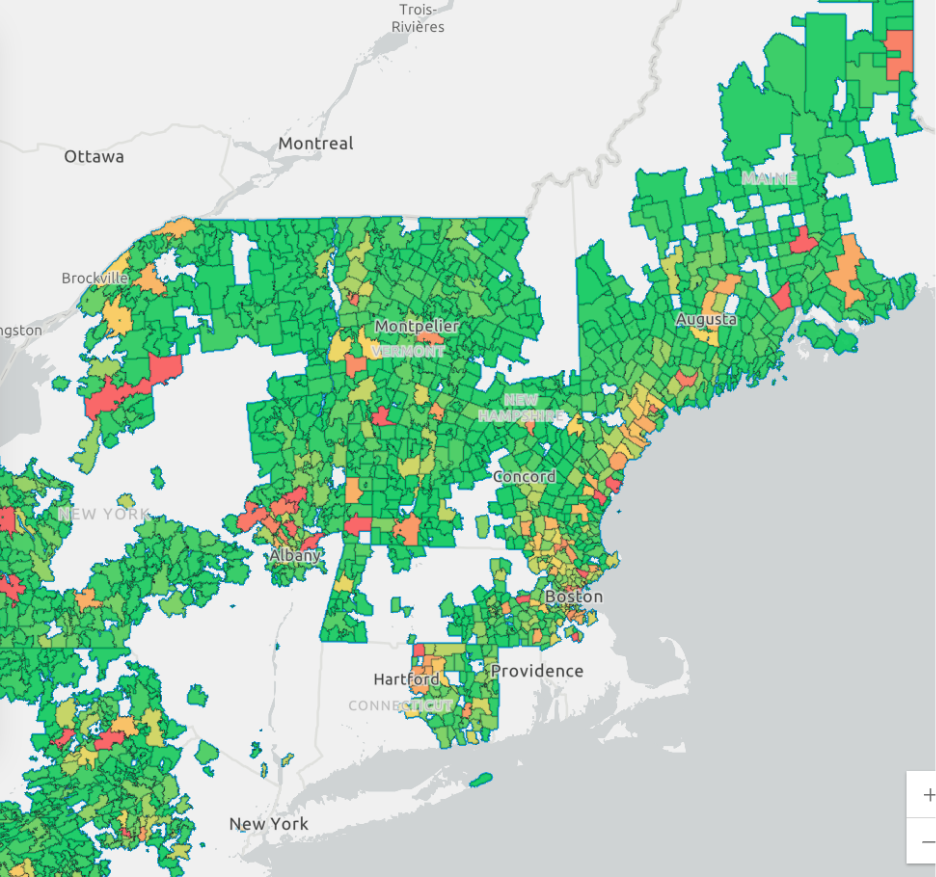
Audience centricity mapping
Orchestrating Omnichannel Experiences
Today’s customers fluidly navigate between digital and physical touchpoints. They research online, purchase offline, encounter local messaging, see national branding, and interact across an ever-expanding set of environments. To meet them where they are, we must orchestrate omnichannel media, not run channel-by-channel campaigns.
This means moving beyond the old dichotomy of “digital for acquisition, offline for brand.” Instead, we need a connected view of the customer’s total behavior—how they come in the door, how they explore, how they convert, and how they return.
Critically, omnichannel planning enables us to understand true acquisition dynamics. For example, a digital prospecting campaign may spark interest, but the final conversion might occur in a physical location. Without integrated measurement, the digital channel gets undervalued; with it, we can quantify the full business impact and optimize accordingly.
For multi-location brands, omnichannel maturity is especially important. Individual stores, regions, or franchisees often experience different customer journeys. To harmonize enterprise strategy with local execution, we need a shared measurement backbone that understands both.
A Measurement Framework That Moves Beyond Last Click
If marketers are going to responsibly invest above the performance line, they need measurement systems that make brand investment as credible as lower-funnel activity. There’s no single magic metric that can do this. Instead, we build a Unified Measurement Framework—a multi-method approach that cross-validates insights and “triangulates truth” rather than betting on one model alone
Marketing Mix Modeling (MMM): The Long-View Foundation
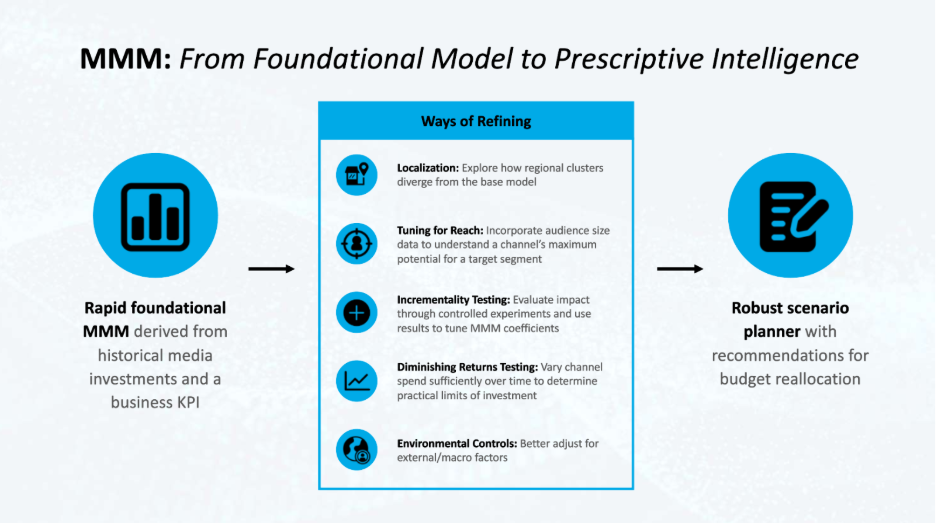
MMM gives us the strategic perspective: a privacy-resilient, statistical view of how each channel contributes to outcomes over time. Modern MMMs can incorporate both short-term and long-term effects, capturing the halo of brand investment as well as the contribution of activation channels. This becomes the anchor for long-term budget allocation, scenario planning, and enterprise-level guidance.
Flighting Variation to Improve Model Accuracy
MMM accuracy improves when media spend has sufficient variation. We intentionally vary flighting to help the model read impact more clearly, ensuring every channel’s contribution is properly captured.
MMM alone isn’t fast enough for optimization. To validate true causal impact, we use incrementality testing, including audience holdouts, geography-based experiments, and platform-level lift studies. These tests answer the essential business question: What would have happened if we didn’t run the campaign?
Holdout designs provide clean causal reads on net-new outcomes. Geo tests allow us to measure lift at scale without user-level tracking. This approach moves us from correlation to causation and provides the kind of rigor stakeholders trust.
Attribution Models: Fast Optimization Signals
Attribution—both rules-based and machine-learning—remains useful for real-time directional guidance, even as privacy changes degrade its absolute accuracy. By integrating attribution insights with MMM and incrementality testing, we get both speed and truth.
Together, these components create a measurement system strong enough to support serious brand investment while retaining the agility performance teams depend on.
Stay Forward
Get exclusive insights into digital media's top-trending topics delivered directly to your inbox.
MMM: From foundational model to prescriptive intelligence
From “ROAS-Only” Thinking to Customer Lifetime Value
The industry’s fixation on ROAS has led many brands to optimize themselves into a corner. ROAS is easy to calculate, easy to report, and deeply misleading. It overvalues existing customers, undervalues net-new growth, and hides the quality of customer cohorts.
We replace ROAS-only thinking with a system grounded in:
Customer Acquisition Cost (CAC)
Customer Lifetime Value (LTV)
Cohort performance over time
Cohort analysis shows us how different acquisition channels, creatives, and audience strategies contribute to retention, repeat purchase behavior, and revenue expansion. Two campaigns with identical ROAS might produce dramatically different 90-day or 1-year value. When you optimize for LTV instead of short-term revenue, you build a healthier, more profitable customer base.
This is especially important for multi-location brands, where customer lifetime value often varies meaningfully across geographies. A location-first LTV view reveals growth pockets and helps allocate media investment more intelligently.
Validating Leading Indicators for Faster Optimization
While LTV is essential, it accumulates slowly. To stay agile, we identify and validate leading indicators—fast-moving signals that correlate with long-term business outcomes. These indicators allow us to optimize upper-funnel media in near real-time while maintaining scientific rigor.
Examples include:
Share of search, which generally serves as a reliable proxy for share of market.
Website visitation and engagement, especially return visits and high-intent behaviors.
Video completion rates, which signal the audience finds content meaningful and often correlate with downstream conversion lift.
Brand recall and consideration metrics from survey-based providers such as YouGov, Morning Consult, Dynata, or Harris Poll.
The key isn’t selecting these metrics—it’s validating that they truly correlate with the business outcomes you care about most. Once validated, they become invaluable tools for fast iteration without sacrificing long-term accountability.
Running Everything as a Test: Building a Culture of Experimentation
The strongest marketing organizations treat testing not as a project, but as a culture. DAC operationalizes this by embedding a lead analyst on every media account—a structural decision that ensures data science and media planning operate as a single team, not separate functions. This creates an “always-on feedback loop” where planners and analysts design tests, execute them, interpret results, and feed insights back into strategy continuously.
Tests become the fuel for learning agendas. Every quarter, we outline the key uncertainties that must be resolved to unlock growth: Which audiences drive the highest LTV? Which creative variants move consideration? Which markets have the most efficient path-to-purchase? Each question becomes a structured experiment. The output is a compounding body of knowledge that improves your marketing system over time.
This continuous experimentation not only improves performance; it builds organizational confidence, especially where brand investment is concerned, because every initiative is designed with measurement rigor from day one.
Transparent Dashboards for Enterprise and Local Stakeholders
For brands with complex internal structures, transparency is as important as accuracy. Clear, role-specific dashboards bring every stakeholder along—from the CFO to regional field teams. When everyone sees the same truth, in formats tailored to their needs, a unified culture of optimization emerges.
These dashboards connect brand and performance metrics, attribution signals, incrementality reads, MMM insights, and leading indicators into a cohesive picture. They ensure the organization can finally answer the boardroom’s most persistent questions: What’s working? What’s not? What’s incremental? Where should we invest next?
The Evolution Toward Predictive Scenario Planning
As data accumulates and MMM models mature, we evolve from measurement to prediction. Scenario planning allows us to forecast the likely outcomes of different investment strategies: What happens if we shift 10% of search budget into video? What if we increase investment in our highest-LTV audience segment? What if we expand brand spend in priority markets?
These tools elevate marketing to a strategic lever for the whole business. They support CFO-level budgeting, empower CMOs to defend brand investment, and provide executives with confidence in decision-making.
Conclusion: Building a Marketing System That Compounds Over Time
Responsibly shifting up-funnel isn’t about abandoning performance. It’s about designing a marketing system that uses brand to supercharge performance, and uses measurement to make that investment credible and scalable.
When we put all the pieces together, we create:
Confidence to invest in long-term brand growth
Proof of incremental value grounded in experiments and MMM
Clear, CFO-ready answers to tough financial questions
A healthier customer base with higher lifetime value
Less dependency on unstable attribution and platform-reported metrics
A marketing system that compounds knowledge, capability, and results over time
This is exactly how DAC is powering leading consumer brands with Enterprise-to-Local marketing. Together, we’ll take your brand forward with a framework built for growth, engineered for truth, and designed to deliver results you can take to the boardroom.
Contributing Experts
Robert Cooney
Vice-President, client strategy
Mentioned in this article
Mentioned in this article
Paid media
Amplify your reach across digital and traditional channels with data-driven paid media strategies designed to deliver measurable business results.