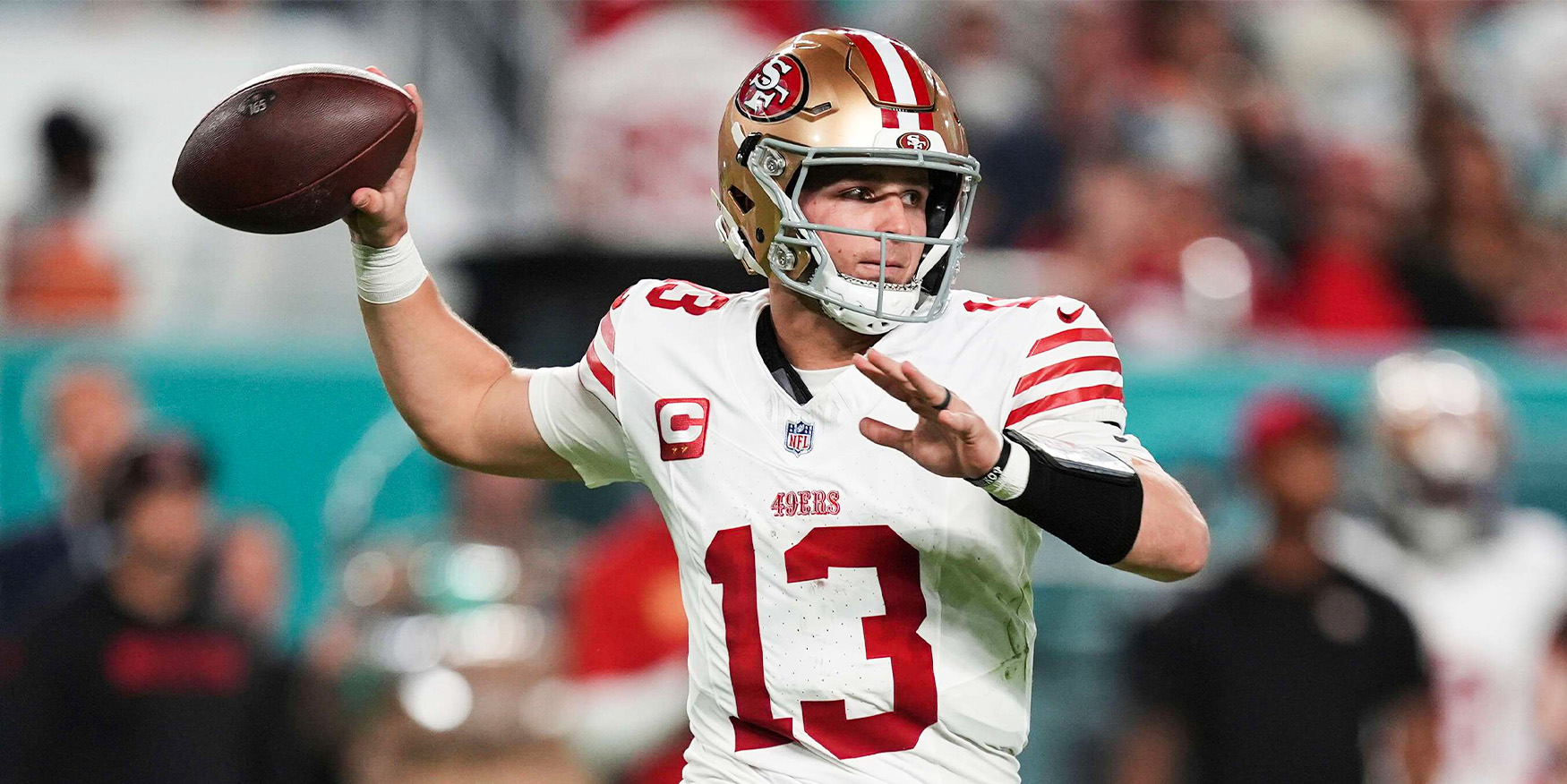
On October 19, 2026, San Francisco 49ers quarterback Brock Purdy became the NFL’s all-time leader in career passer rating. His fifth pass against Washington took him past the 1,500 attempts needed to qualify, and he entered the record books at 105.6, almost three points clear of two-time MVP Lamar Jackson.
For the 49ers, this is good news. Passer rating is one of the most widely quoted measures of quarterback performance, and the team has built its offence around Purdy. If you sat on the board, a record like this is exactly the number you would want to see on the dashboard.
His own coach may be less impressed by the statistic. Kyle Shanahan has called passer rating overrated. What he praises Purdy for is a willingness to do things that lower his rating when they help the team: throwing the ball away rather than taking a sack, or, when the team is behind, attempting the risky pass that might be intercepted because the safe one won’t win the game. Purdy says much the same. He doesn’t finish games checking whether his rating cleared 100; he asks whether he did his job for his teammates.
That is the lesson for any organization that sets up KPIs. Purdy has the best passer rating in history partly because he isn’t playing for it. A quarterback judged and paid on passer rating alone would have every reason to play differently, and worse.
An accurate number can still point the wrong way
Passer rating combines completion percentage, yards per attempt, touchdown rate and interception rate. It is an accurate summary of passing outcomes. But it has two limitations that matter.
First, it credits the quarterback with other people’s work. A perfectly placed pass can be dropped. A short throw can become a long gain through the receiver’s skill. Protection, play design and the opposition all move the number.
Second, it leaves things out. Sacks don’t count against it. A quarterback who holds the ball and takes a sack keeps his rating intact; one who throws it away to avoid the sack is charged with an incomplete pass. On this measure, the worse decision looks better.
None of this makes passer rating wrong. The calculation is correct. The trouble starts when an accurate number is asked a question it can’t answer, such as “who is the best quarterback?”, or when it becomes the thing a player is rewarded for.
When a KPI becomes the job
Once a measure determines pay, promotion or budget, it stops being an observation and becomes an instruction. People will improve the number. Usually that means doing the job better. Sometimes it means finding a cheaper route to the number, and the cheaper route usually runs through whatever the measure can’t see.
This happens at every level of a business:
- A media campaign manager judged on cost per acquisition finds the cheapest conversions come from people who were about to buy anyway: existing customers, brand searchers, recent site visitors. Reported efficiency improves. Additional sales may not, and spend drifts away from the prospecting that builds future demand.
- A CMO reporting attributed revenue sees it rise as the attribution model claims credit for sales that would have happened without the marketing.
- A CFO meets a cost reduction target through postponed maintenance or cheaper, less reliable suppliers. The costs return later, somewhere else in the accounts.
- A head of HR sees time-to-hire fall as roles are filled with the fastest available candidate, and attrition rise a year later.
- A customer service team measured on average handling time gets customers off the phone sooner, and the same customers call back.
In each case nobody has been dishonest. They have done what the measure asked of them. The failure lies in the choice of KPI, not in the people pursuing it.
Start with the question, not the available number
KPIs often earn their place because they are familiar, easy to report or standard across an industry. Those are practical advantages, but they don’t establish whether a measure suits a particular decision.
Monitoring the health of the business, diagnosing a problem, evaluating an initiative and assessing someone’s performance are different purposes. Revenue is essential to the first and almost useless on its own for the last. Before choosing a KPI, decide what you want to understand and what action the answer will inform.
It also helps to separate observing an outcome from attributing it. Profit, revenue and retention have many causes. That breadth makes them valuable indicators of how the business is doing, and unreliable verdicts on any single team. A sales team can perform well while revenue falls because supply constraints stop orders being fulfilled.
Match the measure to the responsibility
Performance measures should reflect the contribution a person or team is expected to make. That doesn’t mean measuring people only on what they fully control; shared commercial goals stop departments hitting their targets while the business misses its own. It means being explicit about how each team’s work connects to the result.
One test is worth applying to any KPI before it is attached to a target: if someone improved this number without improving the business, how would they do it? If the answer comes easily, the measure needs a counterweight.
Compare like with like
Passer rating also shows how comparisons mislead. Passing has become far more efficient over the decades, so recent quarterbacks dominate the list. Jimmy Garoppolo and Tua Tagovailoa rank above Joe Montana and Dan Marino, and Steve Young is the only one of the top 25 whose career began more than 30 years ago. Few would argue Garoppolo was the better player.
Business KPIs drift in the same way. Inflation, seasonality, changes in product mix and shifts between channels can all move a number without any change in underlying performance. Conversion rates for everyday consumables and for expensive, considered purchases reflect different buying decisions, not just different advertising. Revenue per employee varies with business model and outsourcing.
The 1,500-attempt threshold carries a lesson too. Small samples swing wildly, which is why the NFL won’t rank a quarterback until he has thrown enough passes. A campaign judged on its first week, or a new hire on their first month, deserves the same caution.
Know when a KPI isn’t enough
When the question is “did this work?”, no KPI answers it alone. If a campaign, a price cut and wider distribution all launch in the same quarter, a rise in sales can’t be credited to any one of them by choosing a cleverer metric.
Attribution needs a measurement approach. A controlled experiment or holdout test can estimate an initiative’s effect directly. Where that isn’t practical, well-chosen comparisons and statistical models can provide evidence, provided their assumptions and uncertainty are stated. The strength of the claim should match the strength of the evidence.
Build a balanced set
Effective measurement usually pairs an outcome with evidence about its drivers and a check on unintended consequences. A cost target needs a quality measure. A growth target needs a profitability measure. Cost per acquisition needs an incrementality test. Time-to-hire needs twelve-month retention alongside it.
Football analysts already work this way, reading passer rating alongside measures such as expected points added per play. The aim is a small, coherent set that rewards the behavior you actually want, rather than one universal score.
Five questions to ask before setting a KPI
- What decision will this number inform?
- Does it reflect the contribution of the people judged on it, or an outcome they share with others?
- What does it leave out, and could someone improve it by making that worse?
- Are the comparisons like for like?
- What evidence would we need before acting on it?
Purdy’s record is genuine, and the 49ers are right to celebrate it. But the most telling detail is that the player at the top of the list is one who doesn’t play for it. The best KPIs are the ones your people can pursue wholeheartedly, because improving the number and improving the business are the same thing.
At DAC, we help brands connect marketing measurement to business outcomes, combining analytics, experimentation, and strategic insight to understand not just what happened, but what actually drove results. Want to know more? Let’s talk.