Apple Maps ads: What multi-location brands need to know
July 29, 2026
Kyle Harris / Victoria Khinevich
9 min
Technical
Share This
Subscribe
Share This
Subscribe
In short: Apple Maps advertising offers a valuable new way for multi-location brands to capture local search intent, but it isn’t a direct replacement for Google Maps.
The launch of Apple Maps advertising gives brands another way to reach nearby customers at the moment they’re deciding where to go. But the platform differs from Google Maps in how campaigns are purchased, measured, and optimised.
Learn how Apple Maps advertising works, how it compares with Google Maps, and what marketers should consider before investing.
The launch of advertising in Apple Maps has attracted significant attention from brands with bricks-and-mortar locations. The appeal is easy to understand: map users frequently have immediate, location-based intent, making the environment a natural place for businesses to promote nearby stores, branches, restaurants, service centres and other physical destinations.
Maps advertising itself is not new, however, and many advertisers already reach local audiences through Google Maps and related Google products. Although the basic proposition may appear straightforward—show a promoted location when someone searches nearby—the platforms differ meaningfully in how their ads appear, how campaigns are purchased and, most importantly, how performance can be measured. Advertisers should understand these nuances before treating Apple Maps as a direct substitute for Google Maps.
What is Apple Maps advertising?
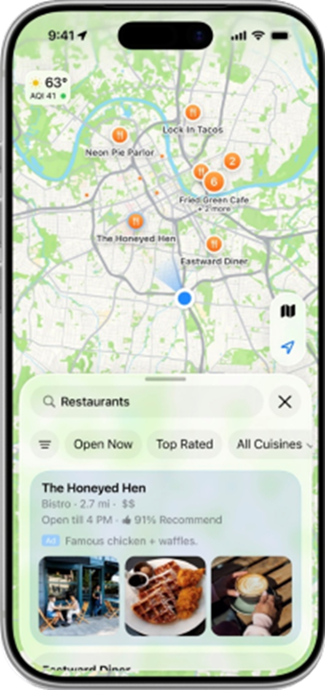
Apple Maps advertising is a location-based advertising product that allows businesses to promote physical locations within Apple Maps when users search for nearby businesses. It’s designed to capture existing local intent rather than generate broad brand awareness.
Apple Maps ads are expected to offer two primary placements: sponsored listings within search results and sponsored recommendations within the Recommended Places experience.
Once a user selects the listing, the experience will direct them to the business’s place card, where they may be able to call, visit the website, or request directions, which is all very standard and familiar to users across various maps platforms.
Apple Maps advertising is primarily a lower-funnel channel that captures existing local search intent rather than creating new demand. It can help a business become more visible at the moment a potential customer is deciding where to go, but it is not designed to generate broad awareness among people who are not already expressing an interest in the category. While this is natural for map tactics, it’s an important distinction as we compare Apple Maps to Google’s capabilities.
Available creative options are also likely to be relatively limited. Rather than supporting multiple headlines and detailed descriptions, Apple Maps ads will focus on the promoted location and a short call to action. The location listing itself—including its name, category, address, imagery, hours, and other business information—will therefore play an important role in the overall experience.
How will advertising on Apple Maps differ from Google Maps?
As Apple Maps advertising launches and matures, advertisers will need to understand how it differs from Google Maps—not only in appearance, but also in how inventory is purchased, controlled, and measured.
Consideration
Apple Maps
Google Maps
How ads are purchased
Apple Maps advertising can be purchased as a dedicated Maps-only placement. This gives advertisers a clearer view of where their media investment is being spent.
Google Maps inventory is generally accessed through Performance Max or Demand Gen campaigns. Depending on the campaign setup, ads may also appear across other Google properties.
Placement control
Apple gives advertisers greater certainty that campaign spend will remain within the Maps environment.
Performance Max offers limited placement control because campaigns can serve across multiple Google channels. Demand Gen may provide more flexibility to prioritise Maps, depending on the available configuration.
Available formats
Apple’s initial offering is expected to focus on sponsored search listings and recommendations within Apple Maps. The product is relatively streamlined and specific to location discovery.
Google supports a broader range of location-based formats, including promoted pins, search ads, suggested locations, Business Profile messaging, and placements within Waze.
Creative options
Apple Maps ads rely heavily on the business’s place card, including its name, category, address, imagery, hours, and other listing information. Advertiser customisation is expected to be limited to a short call to action.
Google allows advertisers to add headlines, descriptions, images, and other assets, similar to its broader advertising products. This provides more flexibility for testing messaging and creative combinations.
Visit measurement
In keeping with Apple’s privacy-focused approach, advertisers can measure actions such as calls, website visits, and direction requests, but not confirmed store visits.
Google can report on store visits for eligible advertisers and campaigns. Some campaign types can also optimise delivery towards location-visit outcomes.
Demand generation
Apple Maps is primarily designed to capture existing local intent. It reaches people who are already searching for a business, category, or destination rather than generating broad awareness.
Performance Max and Demand Gen can use additional Google surfaces to build awareness, influence consideration, and create demand before a user begins searching within Maps.
Audience access
Apple provides direct access to people using Apple Maps within the Apple ecosystem. This may help brands reach an incremental audience that is not fully captured through Google Maps activity.
Google Maps offers significant reach across both Android and iPhone users and benefits from integration with Google Search, YouTube, Waze, and other Google products.
Campaign optimisation
Optimisation is likely to focus on engagement signals such as direction requests, calls, and website clicks. Advertisers may need first-party data, third-party measurement, or controlled testing to connect those actions to visits and sales.
Google provides a more mature optimisation ecosystem, including automated bidding, store-visit signals for eligible campaigns, and integration with other Google advertising and measurement products.
Best strategic role
Apple Maps is best positioned as a focused, lower-funnel channel for capturing high-intent local searches within a controlled Maps-only environment.
Google Maps can support both intent capture and broader demand generation, with greater scale, more formats, and more advanced measurement capabilities.
Overall, Google offers broader scale, more creative flexibility, and more mature visit measurement. Apple provides a more controlled Maps-only environment and access to Apple Maps users at a highly relevant point in the customer journey.
For many multi-location advertisers, Apple Maps should not be viewed as a direct replacement for Google Maps. The stronger approach is to assign each platform a role based on its audience, measurement capabilities, and contribution to broader local marketing objectives.
Stay Forward
Get exclusive insights into digital media's top-trending topics delivered directly to your inbox.
Choosing between Google Maps and Apple Maps
Apple Maps may also help brands reach a valuable segment of iPhone users. Research has consistently shown that iPhone ownership skews towards higher-income consumers, although advertisers should ultimately base channel selection on audience behaviour and campaign objectives.
On the other hand, app usage, campaign KPIs, advertisers’ attribution, and measurement capabilities are important factors to take into consideration when selecting the media channels.
When deciding how to allocate investment between Google Maps and Apple Maps, advertisers should consider:
Campaign objective: Google Maps may be better suited to campaigns focused on driving and optimising towards confirmed location visits, while Apple Maps is more appropriate for capturing active local search intent.
Measurement requirements and capabilities: Advertisers should determine whether calls, website clicks, and direction requests are sufficient performance indicators or whether visit reporting is essential. They should also consider if they can measure footfall and the subsequent lift provided by Apple Maps campaigns via first-party data or third-party tools.
Audience and platform usage: The preferred map applications of the target audience should influence channel selection and budget allocation. While Google Maps is the primary map product for both Android and iPhone users, behaviours can vary over time and within different audiences.
Market competition: Apple Maps may provide incremental value in locations where competitors are highly visible or actively investing in paid map placements. Early adoption can help advertisers get ahead of the competition.
For many advertisers, the strongest strategy is assigning each platform a role based on its strengths rather than choosing one over the other.
Why local presence optimisation matters before advertising
Choosing the right advertising platform is only part of the equation. Before investing in Apple Maps advertising, brands should ensure their local presence is fully optimised. Even the best campaign can struggle if it sends potential customers to an incomplete, outdated, or poorly reviewed business listing.
Apple Maps ads are closely tied to Apple Business place cards, making listing quality a key part of campaign performance. Accurate business information, current hours, high-quality photos, a cover image, and a recognisable logo all help create a stronger first impression when users discover your business through Maps.
Brands should also take advantage of showcases, Apple Business’s promotional feature that allows businesses to highlight limited-time offers, seasonal promotions, new products, or other timely updates directly on their place cards. These updates can make listings more engaging and give potential customers another reason to choose your location.
Reputation is just as important as media investment. Driving paid traffic to a location with a poor rating on Apple Maps or Yelp is unlikely to maximise return on investment. Strong reviews, complete business information, and compelling place cards help convert local intent into customer action—allowing advertising and organic local presence to work together rather than independently.
How should marketers measure Apple Maps campaigns?
Because Apple Maps doesn’t currently report confirmed store visits in the same way Google can for eligible campaigns, advertisers should define success before launching campaigns. Depending on campaign objectives, direction requests, website visits, and phone calls may all serve as meaningful performance indicators. Brands with access to first-party sales data or third-party measurement solutions can also evaluate whether Apple Maps advertising contributes to incremental visits, revenue, or other business outcomes.
Can Apple Maps advertising replace Google Maps advertising?
Not for most advertisers. Apple Maps provides a dedicated way to reach users searching within the Apple ecosystem, while Google Maps offers broader reach, more advertising formats, and more advanced location-visit measurement. For many multi-location brands, the best strategy is to use each platform where it delivers the greatest value rather than treating one as a replacement for the other.
What marketers should do now
Apple Maps advertising gives brands another opportunity to capture high-intent local searches, but success depends on more than simply buying ads. Advertisers should evaluate how Apple Maps fits alongside Google Maps, build campaigns around meaningful business outcomes, and ensure their local presence is optimised before investing. The strongest results come from treating local listings and location-based advertising as complementary parts of the same strategy.
At DAC, we help multi-location brands align organic local presence optimisation with location-based advertising to maximise performance across Apple Maps, Google Maps, and other local discovery platforms.
Whether you’re looking to improve your Apple Business listings, strengthen your local reputation, or launch high-performing Apple Maps campaigns, contact DAC to develop a strategy that ensures your local presence and advertising work together to drive measurable results.