Search is undergoing its most significant transformation in decades. Artificial intelligence, particularly large language models (LLMs) and AI-powered search experiences like Google’s AI Overviews, is changing how people discover information, evaluate options, and make decisions.
For brands, this shift creates uncertainty. Traditional SEO metrics such as rankings, clicks, and organic traffic are becoming less reliable indicators of success. At the same time, many of the foundational principles of SEO still matter deeply. That’s why we’re here to bridge that gap and help marketing leaders understand:
- What has fundamentally changed in search
- What remains critical and should not be abandoned
- How to adapt SEO into a modern visibility strategy that works in an AI-driven environment
Rather than focusing on theory, this guide provides a practical, step-by-step framework that brands can use to move forward with confidence. Let’s get started.
Understanding the new search journey
For most of its history, online search has followed a predictable pattern:
- A user entered a keyword or query
- They reviewed a list of results
- They clicked through to a website
- They refined their search if needed
In an AI-driven environment, this journey looks very different.
AI systems are now guiding users through the exploration process. Instead of repeatedly searching and clicking, users are increasingly engaging in ongoing conversations. The AI asks clarifying questions, compares options, and synthesizes information on the user’s behalf.
This introduces a new and critical phase in the journey: AI-guided clarification.
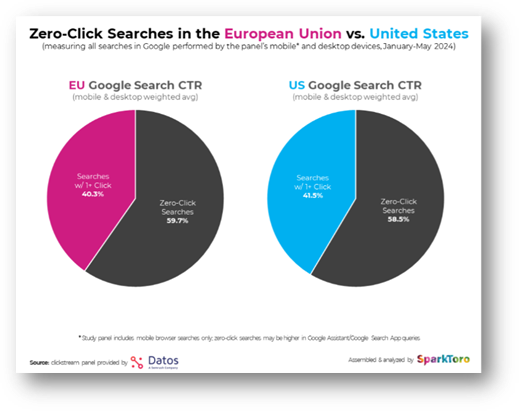
Many decisions are now influenced, or even made, before a website visit occurs. In some cases, the visit never happens at all.
Zero-click searches data, Europe vs United States
What does this mean for brands?
- Visibility increasingly happens inside the answer, not just on the website.
- Influence can occur even without a click.
- SEO success is no longer defined solely by traffic volume.
In other words, SEO isn’t suddenly less important—but it does need to evolve.
What still matters: The unchanging fundamentals
Despite dramatic changes in interfaces and user behavior, the core foundations of SEO remain essential.
AI systems still rely on signals that indicate:
- Technical accessibility and clarity
- Content relevance and usefulness
In fact, AI often amplifies the importance of these fundamentals. When AI summarizes information or recommends brands, it draws from sources it perceives as reliable, consistent, and well-structured.
Key SEO basics that still apply
- Strong technical foundations (crawlability, structured data, performance)
- Clear information architecture
- Content that genuinely satisfies user intent
- Demonstrable expertise and credibility
- Consistency across owned and earned digital properties
AI does not replace these requirements, but instead rewards brands that execute them well.
The 6-step framework for AI-ready SEO
This framework translates the realities of AI-driven search into a practical roadmap brands can follow. It focuses on building the structural clarity, trust signals, and content foundations AI systems rely on—the goal being to drive visibility as search continues to evolve, not just today.
Step 1: Conduct an AI readiness audit
An AI readiness audit expands the traditional SEO audit to reflect how modern search systems interpret information.
Rather than focusing only on technical health, this audit evaluates how effectively AI systems can understand, trust, and surface your brand.
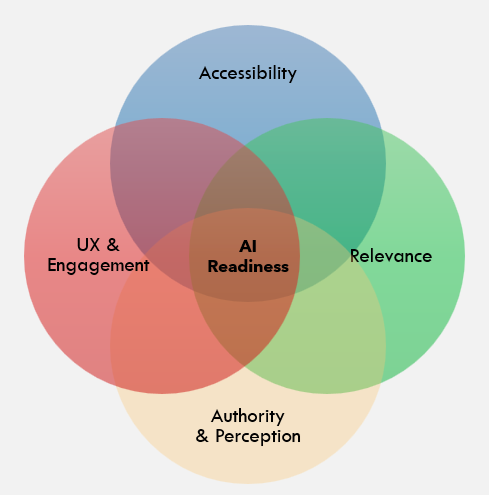
Core audit dimensions
- Accessibility: Is your content easy for search engines and AI systems to crawl, parse, and interpret?
- Relevance: Do your pages clearly communicate topical focus and relationships?
- Engagement: Are users interacting meaningfully with your content across formats?
- Authority: How strong and consistent is your brand’s presence across the wider digital ecosystem?
Importantly, this audit extends beyond your website. AI systems draw from reviews, third-party content, expert commentary, and community discussions.
Outcome
The goal is not a long checklist. The goal is a prioritized roadmap that identifies where improvements will most directly improve AI visibility and brand representation.
Step 2: Create content that AI can easily interpret
AI systems process content differently than humans. They break information into smaller units, look for patterns, and compare meaning across sources. Content that is vague, overly complex, or poorly structured is less likely to be surfaced.
Practical content principles
- Use plain, accessible language
- Keep paragraphs concise and focused on one idea
- Use clear, descriptive headings
- Provide direct answers before supporting detail
One of the most effective approaches is building topic clusters. Instead of isolated pages targeting individual keywords, clusters of interlinked content comprehensively cover a subject area.
This helps AI systems understand
- relationships between concepts.
Content that is easy for AI to extract is also easier for humans to consume, making this approach a win for both.
Step 3: Use existing search performance as an AI roadmap
Traditional SEO data remains extremely valuable when used strategically.
One of the fastest ways to improve AI visibility is identifying content that
- already performs well in organic search
- but is not appearing in AI-generated answers or summaries.
This gap is rarely caused by irrelevance. More often, it is due to structure, formatting, or missing clarity.
How to act on this insight
- Identify high-performing pages in traditional search.
- Check whether those topics trigger AI-enhanced results.
- Prioritize pages where your brand is absent or underrepresented.
- Optimize those pages for clarity, structure, and explicit answers.
This approach delivers high return because it builds on existing strengths rather than starting from scratch.
Step 4: Learn from community and conversational language
Online communities reveal how people actually think, speak, and ask questions, and often more accurately than keyword tools alone.
Discussion forums, Q&A platforms, and peer-to-peer conversations highlight
- common comparisons, and the
- emotional drivers behind decisions.
In turn, these language patterns closely resemble how users prompt AI systems.
Common conversational patterns
- “Which is better: X or Y?”
- “What’s the best option for my situation?”
By translating these patterns into structured, on-site content, brands align more closely with both user expectations and AI comprehension.
Step 5: Treat video and engagement assets as search signals
Video has become a primary discovery format across many categories. It frequently appears in search results and plays a growing role in decision-making.
From an AI perspective, video contributes to engagement signals and provides additional context about products, services, and expertise. As such, a balanced video strategy should include:
- On-site video: Enhances clarity, engagement, and comprehension.
- Off-site video distribution: Meets audiences where they research and compare options.
Video should not be viewed only as an awareness tactic. When used strategically, it supports performance and conversion throughout the journey.
Step 6: Reinforce local and trust signals
For location-based businesses, AI relies heavily on existing local data sources. That means
accurate business information, strong reviews, and consistent reputation management remain foundational. In fact,
AI-driven local recommendations are powered by the same signals that have always mattered:
- Consistent NAP (Name, Address, Phone) data
- Rich profiles with photos and services
AI does not introduce a new local playbook. Rather, it reinforces the importance of executing the fundamentals consistently and at scale.
Measuring success in an AI-driven world
Measurement must evolve alongside strategy.
While traffic and rankings still provide useful context, they no longer tell the full story. Instead, brands need visibility metrics that reflect how AI systems represent them. That could include:
- Brand mentions and citations in AI responses
- Share of voice across key topics
- Sentiment and positioning
- Engagement quality on owned properties
- Downstream business impact (leads, conversions, revenue)
The goal is not to abandon traditional metrics, but to complement them with indicators that reflect influence earlier in the journey.
From SEO tactics to visibility strategy
SEO is no longer a siloed discipline focused solely on rankings and traffic.
It is the foundation of a broader visibility strategy. One that spans content, technology, authority, engagement, and trust across a distributed search ecosystem.
Brands that adapt now will not only protect performance but gain an advantage by influencing decisions before the click ever happens.