Temu and Shein in 2026: How their stop-start spend is reshaping ad auctions (and what media buyers should do)
March 30, 2026
Mariana Nasreddine
12 min
Technical
Share This
Subscribe
Share This
Subscribe
Performance media in 2026 is becoming harder to read. Across channels, advertisers are seeing sudden cost shifts even when nothing inside their accounts has changed.
Much of that volatility is being driven by a small number of outsized spenders, most notably Temu and Shein. Both brands have scaled rapidly through paid acquisition, often becoming dominant buyers across Google and Meta. When they increase spend, costs can rise quickly. When they pull back, pressure can ease just as fast.
For media teams, the challenge is not just higher costs—it’s understanding when performance changes are driven by the auction, not the account. So, let’s take a closer look at how that volatility shows up across channels, how to recognize it in-platform, and what media buyers should do to respond with clarity and discipline.
What changed heading into 2026
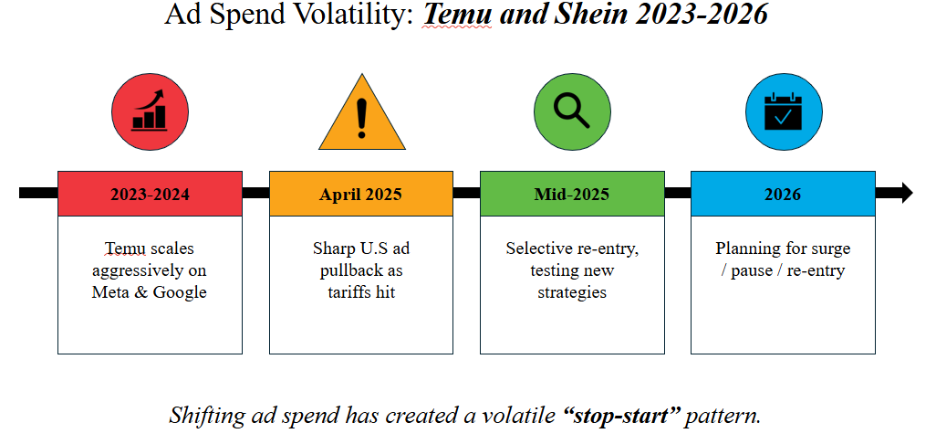
Temu’s U.S. growth story has been closely tied to paid media. The Wall Street Journal reported that Temu was Meta’s top advertiser by revenue in 2023 and among Google’s top five advertisers by spend—an early indication of how quickly one brand’s acquisition strategy can become a market force.
Then the underlying economics changed. In spring 2025, multiple outlets reported sharp pullbacks in U.S. ad spend as tariffs and shipping-rule changes put pressure on the unit economics of low-cost cross-border retail. The Financial Times, citing Sensor Tower estimates, reported that Temu cut U.S. ad spending across major platforms and stopped spending on Google Shopping after April 9, 2025. The Verge also reported that Temu and Shein were raising U.S. prices ahead of tariff changes and the end of de minimis treatment.
Crucially, this did not look like a permanent exit from performance channels. It suggested a willingness to increase or reduce spend based on economic conditions, creating a recurring pattern of surges, pauses, and re-entry that other advertisers now need to plan around. That interpretation is also consistent with broader reporting that Temu and Shein reduced U.S. ad spending materially as trade pressure intensified.
Europe adds another layer of volatility. In November 2025, the European Commission said EU member states had reached political agreement to remove the €150 customs duty exemption threshold for e-commerce imports as of 2026. That change, alongside broader customs reform, reinforces the same point: in a market shaped by shifting policy and pressured unit economics, large advertisers can move faster than most brands are built to respond.
How the pressure moves through auctions
Understanding where that pressure shows up is critical, because it doesn’t affect every channel in the same way.
Why Shopping and Commerce intent move first
Commerce intent is concentrated. When an outsized bidder increases coverage and bidding intensity in Shopping, media costs can rise quickly and impression share can shift just as quickly. When that bidder pulls back, auction pressure can ease just as quickly.
This is why the stop-start pattern appears so clearly across Google’s commerce channels. In April 2025, Search Engine Land reported, citing Smarter Ecommerce analysis, that Temu shut off U.S. Google Shopping ads on April 9 and that its Shopping presence declined rapidly in the days that followed—an illustration of how quickly a single outsized bidder can change commerce-intent auction conditions.
That same competitive pressure can extend beyond Shopping. Reuters reporting described Temu and Shein bidding heavily on competitors’ search keywords during peak retail periods, contributing to higher CPC pressure on high-demand terms. Their influence does not need to be confined to direct product overlap to affect performance. In practice, it can raise costs across shared intent pools and adjacent categories.
Why paid social relief is often less direct
Social auctions are broader and more blended, with many advertisers, objectives, creatives, and audiences competing simultaneously. Even when a major spender pulls back, CPMs do not always reset cleanly because demand can be replaced quickly, and delivery systems may take time to stabilize after a regime change.
The practical effect is that premium campaigns can come under pressure in two ways. Prospecting CPMs may remain elevated longer than expected, and audience mix can skew more value-seeking during periods of heavy discount saturation, making it harder for premium positioning to convert efficiently. In those moments, relying too heavily on broad prospecting can become a fragile strategy.
This is one of the most important distinctions for media teams in 2026: Shopping often reflects the shift first and most visibly, while social may absorb that same pressure in a less direct and less proportional way.
How to recognize the signal in-platform
If Temu or Shein are affecting performance, the first step is not to assume something inside the account broke. It is to look for evidence that auction conditions changed before adjusting creative, bids, or structure.
In Google Ads, that signal often appears first in Auction Insights. A sudden increase in Temu or Shein visibility, combined with rising CPCs and declining impression share, is often a strong indication that competitive pressure has intensified. If conversion volume and ROAS begin to weaken while conversion rate remains relatively stable, that is another sign that the issue may be auction-driven rather than on-site. Search terms can add useful context as well. If more generic, high-volume queries begin to account for a larger share of clicks, traffic quality may be shifting at the same time costs are rising.
In Meta, the pattern is less direct but still visible. If CPMs rise while conversion rate and site behavior remain steady, it is often more useful to interpret that first as a delivery or auction shift than as a creative problem. This is especially important for premium brands, where broad prospecting can become more fragile during periods of heavy discount-led competition. In those moments, a heavier reliance on first-party audiences, warmer segments, and value-based signals often creates more resilience than continuing to push scale through broad cold targeting alone.
What volatility does to performance teams
One of the most costly effects of stop-start competition is false learning. When auction conditions change abruptly, teams often interpret the shift as proof that creative, landing pages, or account structure stopped working. That misread can trigger a wave of unnecessary adjustments—budget changes, rebuilds, target resets, or learning disruption—at exactly the moment platforms need stability.
The reporting view can make that problem worse. Monthly averages often smooth over real operating conditions by blending a surge period with a pullback period into a single, seemingly stable number. What looks calm in a monthly summary can feel highly unstable in practice. In a market shaped by abrupt competitive shifts, weekly visibility is the minimum. During more active periods, teams may need daily monitoring to understand whether performance changes are coming from auction pressure or from something they actually control.
Why this is a governance issue, not just a media issue
The most durable response to auction volatility is not simply faster optimization. It is a clearer operating model—one that prevents external shifts from triggering internal overreaction.
A useful way to think about that process is simple: detect, diagnose, decide, then deploy. Teams need to recognize regime change early, distinguish auction-driven movement from site or creative issues, decide what should and should not change during that period, and only then act through pre-approved adjustments. The value of this approach is less about speed for its own sake and more about preserving discipline when volatility makes everything feel urgent.
A small number of governance decisions can make that discipline much easier to maintain. Agreeing in advance on acceptable variance bands helps teams avoid escalating every short-term swing. Establishing decision rights is equally important: teams should know who is allowed to change budgets, targets, or structures during volatile periods, and what evidence is required before those changes happen. In practice, a weekly competitive review is often enough under normal conditions, with daily checks reserved for major retail moments, policy milestones, or sudden changes in Auction Insights.
How to buy more effectively in a stop-start market
In a stop-start market, the objective is not to eliminate volatility but to build a media operation that can absorb it without losing discipline. That starts with budget and structural flexibility. Teams that can move spend by geography, channel, or category without forcing disruptive rebuilds are better positioned to respond when conditions shift. Monitoring also needs to evolve beyond simple cost tracking. The real goal is to detect when the auction environment has changed so optimization posture can change with it.
The same principle applies when pressure eases. Pullbacks should not simply be treated as welcome relief; they should be treated as opportunity windows. Brands that are prepared to increase budgets selectively, loosen constraints where margin and lifetime value allow it, or expand into previously crowded areas can often capture more value from those moments than brands that remain static.
When pressure returns, the response should be equally deliberate. That usually means concentrating spend in the most defensible segments, reducing exposure to lower-margin areas that are highly sensitive to CPC inflation, and keeping creative changes measured rather than reactive. Over time, this also reinforces the importance of channel diversification and lifetime value discipline. Brands that rely too heavily on a single auction type, or that optimize only to blended ROAS, are more exposed when competition becomes unstable.
Planning for multiple scenarios
Scenario planning is a rational response to policy-linked economics that can change quickly. A single forecast line assumes a level of stability this market no longer offers.
For some brands, the most likely scenario is re-acceleration, where competitive pressure remains elevated and efficiency depends on defending the most resilient segments. For others, the more realistic outcome may be selective buying, where pressure concentrates in specific geographies, product categories, or audience cohorts and requires faster reallocation. Regulatory shock remains the third scenario teams cannot ignore: abrupt pullbacks or geographic rebalancing can create short-lived openings, but only for brands that have flexible budget and clear rules for stepping into them.
The value of scenario planning is not just in naming possibilities. It is in defining, ahead of time, what each scenario means for CPM and CAC by channel, where budgets should be protected or expanded, and what signals indicate which environment you are actually in.
What matters most next
The most useful watchlist is not a long list of possible risks, but a focused view of the signals most likely to change the operating environment quickly.
Policy and regulatory developments remain central because they can alter the economics behind Temu and Shein’s acquisition strategy with very little notice. At the platform level, the clearest early indicators are usually found in commerce-intent signals such as Auction Insights movement, impression share shifts, and sudden changes in competitive presence. On social, the more telling pattern is often a change in CPMs without a corresponding change in site behavior or conversion stability, especially when delivery constraints begin to appear at the same time.
Behavior in market matters as well. Aggressive promotional pushes, broader coverage strategies, or sudden changes in acquisition intensity can all signal that a new surge period may be forming. The goal is not to predict every move in advance. It is to recognize quickly when the environment has changed enough to require a different response.
What teams should do now
The operating challenge in 2026 is a less predictable market, where large competitors can change auction conditions quickly and unevenly. For media teams, that means the response cannot rely on static planning alone. It needs to be faster, more disciplined, and more sensitive to where pressure is actually showing up.
1. The game did not just get more expensive—it got less predictable Teams should prepare for volatility in advance by setting response thresholds, defining trigger signals, and agreeing on which levers can be used when conditions change quickly.
2. Big players (Temu, Shein) are moving the market Major shifts in their visibility or competitive overlap should be treated as signals that auction conditions may have changed before account-level fixes are made. Review brand value props and differentiation as part of market and auction signals is critical.
3. The auction moves in pockets (geo + audience), not evenly Teams that segment performance more closely can often find efficiency by tightening exclusions, expanding negatives, adjusting bids, and shifting spend toward less pressured areas.
4. Most brands are reacting too slowly Volatility windows require faster signal detection, clearer decision rights, and the ability to move budget or tighten strategy without delay.
5. The biggest risk is misdiagnosing the problem Before changing creative, landing pages, or structure, teams should confirm whether the shift began in auction or market conditions.
6. Winning in 2026 means operating like a trader, not a planner The strongest teams will pair scenario-based planning with pre-approved actions so they can defend efficiently and expand deliberately as conditions change.
At DAC, we help brands turn volatile auction conditions into a more stable operating system by combining competitive monitoring, disciplined measurement, and agile orchestration across channels. For brands looking to assess whether auction volatility is creating hidden risk or opportunity in their 2026 plans, this is exactly the kind of pressure-testing that matters.
Contributing Experts
Mariana Nasreddine
Mentioned in this article
Mentioned in this article
None (Draft)
Explore more insights
Stay Forward
Get exclusive insights into digital media's top-trending topics delivered directly to your inbox.